Most futures traders assume their biggest problem is entries.
For a long time I thought the same thing. I would review losing days and focus on the individual trades that went wrong. Bad timing, poor levels, chasing moves. It always felt like the issue was execution on specific setups.
After reviewing my ES and NQ trade history more carefully, a different pattern started to appear.
The problem was not always bad trades.
The problem was trading too much.
Overtrading is one of the easiest problems to miss because it often hides inside otherwise normal trading days. You can even have profitable days while still building habits that slowly damage your performance.
Looking at execution data instead of memory made the pattern obvious.
Import your NinjaTrader executions directly into EdgeGhost to make overtrading patterns easier to spot in the session data.
If you want the broader review framework behind this, start with How to Review a Futures Trading Day (Step-by-Step).
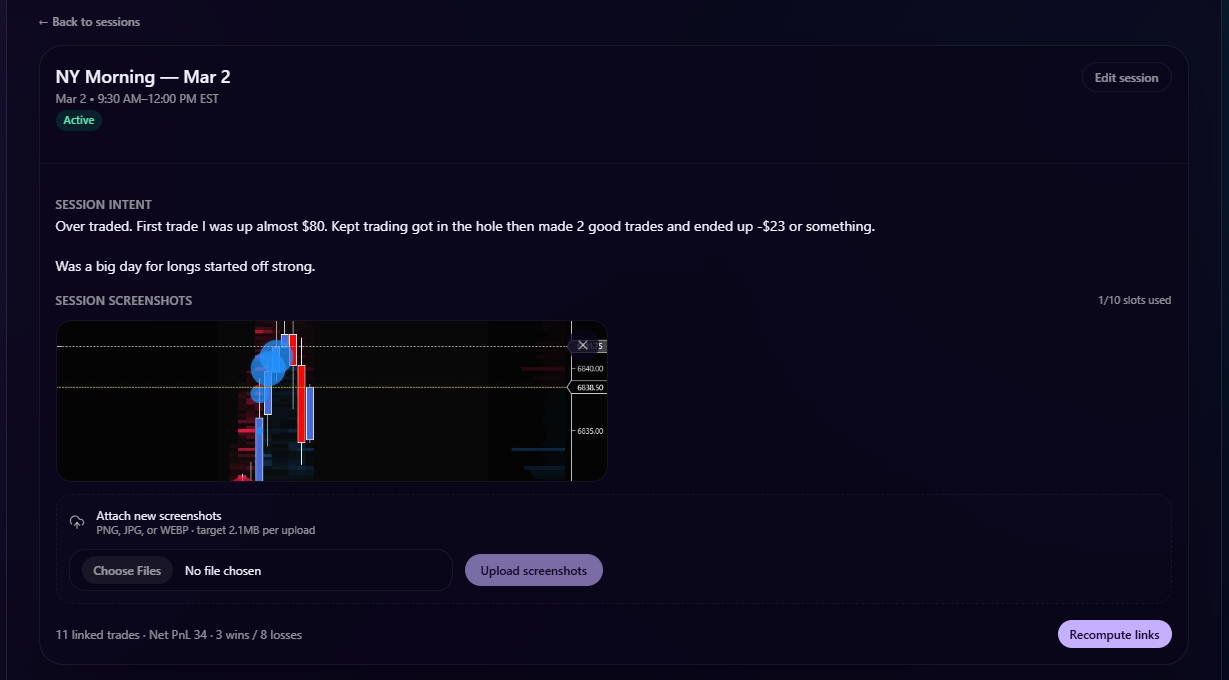
The Overtrading Pattern
On many trading days the early trades were solid.
Entries followed the plan. Risk stayed controlled. Decisions were deliberate.
Later in the session things started to change.
Position size would creep higher. Trades would come closer together. Stops would get adjusted more often. Decisions became faster and less structured.
The number of trades increased while the quality of decisions decreased.
Some days still ended green, which made the problem harder to notice.
But when trades were grouped by session instead of just daily PnL, the pattern became clear. The first part of the session often carried the results, while later trades gave a large portion of it back.
Without structured review, those differences were easy to miss.
What Overtrading Actually Looks Like
Overtrading does not always mean taking dozens of trades.
Sometimes it shows up in smaller ways.
Performance started to shift after a certain number of trades. Losses became slightly larger than planned. Trades were taken in conditions that would normally be skipped.
Small discipline changes accumulated over the course of the session.
Common signs included:
- Taking trades without a clear reason after a loss
- Increasing size after a drawdown
- Entering marginal setups late in the session
- Moving stops more often
- Trading when conditions were no longer clean
Each individual decision seemed minor at the time. Together they created a measurable difference in results.
Why Most Traders Miss It
Many traders review performance at the daily level.
A day might finish positive and look successful on paper.
That same day might include several trades that violated normal rules or risk limits.
Green days can hide bad trading.
When performance is measured only by total PnL, it is difficult to see how discipline changes during a session.
Manual journals help, but they often rely on memory and subjective notes. Over time it becomes difficult to maintain consistent structure.
Execution data makes the patterns easier to see because trades can be grouped by time of day, session, and behavior instead of just final results.
For a deeper breakdown of execution mistakes in dollar terms, read How to Analyze Futures Trades and Find Costly Trading Mistakes.
What Helped Fix It
The first step was recognizing that overtrading followed a pattern.
It usually appeared after a sequence of trades rather than at the start of a session.
Once that became clear, simple guardrails made a noticeable difference.
Examples included:
- Setting a soft limit on the number of trades per session
- Reducing size after consecutive losses
- Stopping early when market conditions changed
- Reviewing sessions instead of individual trades
These changes did not improve entries or exits directly. They improved consistency.
Performance became more stable because fewer trades were taken in low quality conditions.
How the Pattern Became Visible
The overtrading pattern became obvious once trades were reviewed by session instead of just by day.
Seeing trades grouped by session and time of day made it easier to spot when discipline started to slip.
Instead of asking whether a day was green or red, the review process became more focused on how the trades were taken.
That shift made it easier to identify which parts of the session produced consistent results and which parts created unnecessary risk.
Trade history alone is just data.
Structured review turns that data into useful information.
If you use NinjaTrader and want a cleaner fill-export workflow behind this type of review, see the NinjaTrader Trade Journal Guide.
If you want to review your own sessions using execution-based analysis, you can explore EdgeGhost here: