Most futures traders know they should review their trades.
Very few actually know how to do it properly.
Many traders finish the day, glance at their PnL, and move on. Others keep a journal but never turn it into a structured review process. Over time, mistakes repeat and improvement slows down.
Consistent traders do something different. They review their sessions in a structured way and look for patterns in execution, risk management, and decision making.
A proper review does not need to take an hour. A focused 10–15 minute process is usually enough to identify what actually matters.
This guide outlines a simple review process that works well for intraday futures traders.
Import your NinjaTrader executions directly into EdgeGhost to review the full session in one place.
If you are still building the journaling workflow itself, start with How to Start a Futures Trading Journal (NinjaTrader Guide).
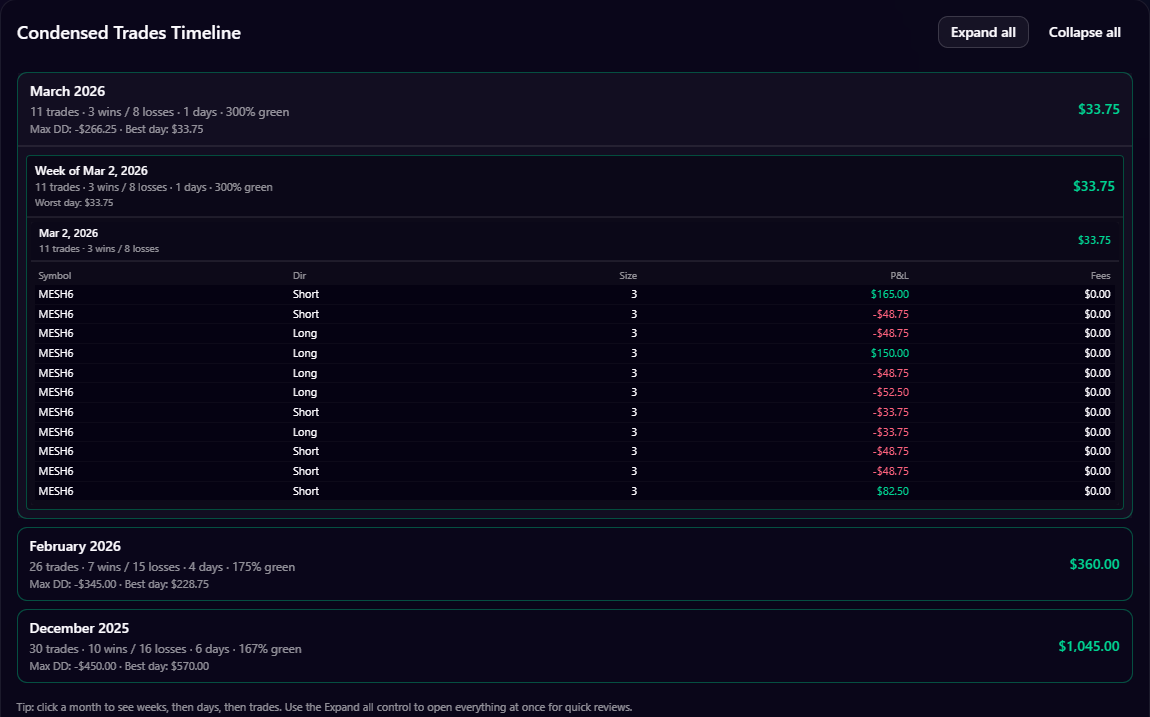
Step 1: Reconstruct the Trading Session
Start by looking at the session as a whole instead of focusing on individual trades.
Key things to look at include:
- Session PnL
- Number of trades
- Time of day traded
- Largest win and loss
- Overall trade frequency
The goal at this stage is to understand what kind of session it was.
Ask simple questions:
- Was this a normal session or an unusual one?
- Did I follow my planned trading hours?
- Did I stop when conditions changed?
- Did I trade more than expected?
Many problems become obvious when you zoom out and look at the session instead of individual trades.
For example, a trader might discover that most losses happen late in the session, or after the first losing trade. Those patterns are difficult to see when trades are reviewed individually.
Step 2: Identify Execution Mistakes
Once the session is clear, look for execution mistakes.
These usually have the biggest impact on results.
Common examples include:
- Oversizing trades
- Moving stops
- Taking trades outside the plan
- Entering too early or too late
- Continuing to trade after reaching a loss limit
Most traders already know their typical mistakes. The important part is identifying when those mistakes actually happened.
Instead of writing long notes, focus on what can be measured.
For example:
- Did losses exceed planned risk?
- Were position sizes larger than usual?
- Did trade frequency increase after losses?
Execution mistakes are where most performance improvement comes from.
Step 3: Identify What Went Well
Review should not only focus on mistakes.
Strong sessions often reveal patterns that are worth repeating.
Look for examples of:
- Well-timed entries
- Clean exits
- Following planned risk
- Stopping at the right time
- Good decision making during volatility
Understanding what works is just as important as identifying what does not.
Many traders unintentionally remove profitable behaviors while trying to eliminate mistakes.
A balanced review process prevents that.
Step 4: Choose One Improvement
One of the biggest mistakes traders make during review is trying to fix everything at once.
Large lists of improvements rarely translate into real change.
Instead, choose one specific adjustment for the next session.
Examples include:
- Limit trading to the morning session
- Reduce position size during volatile conditions
- Stop trading after a set number of trades
- Respect planned stops without adjustment
Keep the change simple and measurable.
Small improvements repeated consistently produce better results than occasional major changes.
Step 5: Track the Next Sessions
The final step is following through.
An improvement only matters if it shows up in future sessions.
At the start of the next trading day, remind yourself of the adjustment you chose.
After the session, check whether it was followed.
This closes the feedback loop between review and execution.
Over time, this process builds consistency and makes improvement measurable.
Why Structured Review Matters
Trade history alone does not lead to improvement.
Improvement comes from understanding how trading decisions affect results.
Many traders have hundreds of recorded trades but still struggle to identify patterns in their performance.
Structured review turns raw trade data into actionable feedback.
Instead of guessing what went wrong, traders can identify specific behaviors and adjust them.
This process is especially important in futures trading, where small discipline mistakes can compound quickly.
Making Review Practical
A good review process should be simple enough to repeat every day.
If review becomes complicated or time consuming, consistency usually disappears.
The goal is not to create detailed reports. The goal is to build a repeatable process that highlights what actually matters.
Tools that automatically reconstruct trades and sessions can make review significantly easier because the data is already organized around actual executions.
When sessions and trades are linked automatically, review becomes faster and more objective.
If your biggest issue is hidden discipline drift later in the day, read What My ES and NQ Trade Data Taught Me About Overtrading.
Final Thoughts
Review is where trading improvement happens.
Without review, traders tend to repeat the same mistakes and rely on memory instead of data.
A simple structured process makes improvement measurable and keeps progress moving forward.
Even a short daily review can reveal patterns that would otherwise stay hidden.
Consistency in review often leads to consistency in trading.
For deeper mistake analysis beyond the daily routine, see How to Analyze Futures Trades and Find Costly Trading Mistakes.